Posts

'IS SCIENCE A SOLUTION TO EVERYTHIG OR SCIENCE IS THE END TO EVERYTHING'

 It shocks me that I used to be such a book worm and a writer growing up. However, lately I cannot express my words in writing but rather in silence.  I studied science in high school and also my first degree was the Bachelors of Science in Human Physiology, Genetics and Psychology. Having to integrate this science degree with Psychology gave me an awakening or rather it challenged me to ask myself if science is really a solution to everything or an end to everything. Science cannot solve all our problems. While science can help battle things such as diseases, hunger and poverty when used properly. It does not do so completely and automatically. It is evident that most scientists are born. Most of them start at a young age by exploring things around them, experimenting on how things work etc. through observation of the physical world. Yet, understanding how the physical world works solves no problem. For example, it is through science that we know that excersing can lower your...

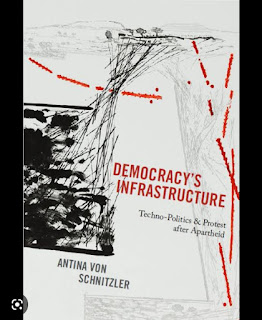
PODCAST IDEAS " DEMOCRACY'S INFRASTUCTURE

 What  I have found most interesting in my book is how operation 'Gcina amanzi' Zulu for operation save water became such a controversial initiative that people in Soweto opposed it for so many reasons. Rent Boycotts and they ended up duging out pipes as a counter campaign that activists called 'Operation Vul'amanzi' (Zulu for ' let the water flow)'.  The question that I will like to focus on is how did an infrastructure upgrading project become the subject of such passionate protests? Today, in the post apartheid South Africa we have a number of protests and they all came in to being because of one protest against prototypes in Soweto, against water meters. The book subsequently follows the prepaid meter into the post apartheid era to examine its role in recurrent service delivery protests, as well as to consider what it reveals about the history of neoliberal policies in South Africa more generally.  The book further explains the rent boycotts that began i...

How reproduction became central to governing the economy and how this manifests in daily lives of women

Image
How reproduction became central to governing the economy My book is called the Economization of life , and it explores reproduction and population control through the lens of the economy, capitalism, fiscal policies, and GDP. It introduces us to John Maynard Keynes. Keynes is a Cambridge economist who helped to bring macroeconomy into the world through his 1936 text The General Theory of Employment, Interest and Money text. The Keynesian revolution is believed to have brought the invention of new terminology and units of analysis in economics. His stance on microeconomic would help govern capitalism and ensure that it maximises employment and wealth while minimising crashes and suffering. The aim of the economy is to use fiscal policies to control inflation, bring down unemployment and stimulate investment and Keynes theory plans against poverty and prepares for war and uses state spent money to build infrastructure such as roads, bridges, and immigration.  Keynes considered eugeni...

Podcast Ideas

 The key things I would want to discuss in my portion of the podcast are positionality and the influences of colonialism. With regards to positionality, there's the how and why the author marks people, other examples of it in science and the examples the author uses to highlight the importance of positionality. The author incorporates positionality, influenced by indigenous North American approaches, by 'marking' people in the way that they 'mark' themselves. This is done with the tribe or settler position placed in brackets after the first time their name is mentioned. The reason the author does it is because indigenous authors often acknowledge their own tribal contexts in the way that non-indigenous authors don't. The exclusion of settler positionalities further perpetuates Whiteness as the default. One of the examples that the author uses was from when they were collecting fish guts for research from fisherman, functioning under the assumption that it was wa...

A-R-T of Exclusion: How Technology Shapes Race and Reproductive Desires

Image
With a world categorized by seemingly never-ending access to media and information, it’s important to strike a balance between producing content that can break through the void while maintaining information that is valuable to creators, thinkers, and activists across multiple generations. They are always looking for new ways to express themselves and share their ideas with the world. So how do I find that right balance of ingredients needed to incorporate the roles of Assisted Reproductive Technology in reproducing race and connecting it to the scholarship of Feminist STS AS WELL AS relating to the inputs of my co-podcasters? Well, I’d like to tackle it by prioritizing strategic omission and targeted audience engagement. Let’s talk about it.  Assisted reproductive technologies (ARTs) are medical procedures that help couples conceive a child. These technologies have been around for several decades, and their use has become increasingly popular over the years. However, while ARTs hav...

Link

 This important information can be found here

HOW ELECTRICITY METERS CAME ABOUT

Image
  This book by Antina von Schnitzler an anthropologist and assistant professor in the Graduate Program in International Affairs at the New School. The book focuses in South Africa's "miracle transition" and how it has been interrupted by waves of protests in relation to basic services such as water and electricity. The author explores a controversial project to install prepaid water meters in Soweto. She follows engineers, utility officials, and local bureaucrats as they consider ways to prompt Sowetans to pay for water and she shows how local residents and activists wrestle with the constraints imposed by meters. Below is a time line of how electricity meter came about. DEMOCRACY'S INFRASTRUCTURE, APARTHEID DEBRIS   Von Schnitzler, A. 2016.  Democracy’s infrastructure : techno-politics and protest after apartheid. Princeton: Princeton University Press. JULY 2004.  One of the 1st large scale violent expressions of discontent in the post apartheid period, the protest...